

|
Date: Nov. 10 & 11, 2026 - Location: Dark Sky Observatory, Fort Davis, TX
Click on displayed images to view at higher resolution.
|
|
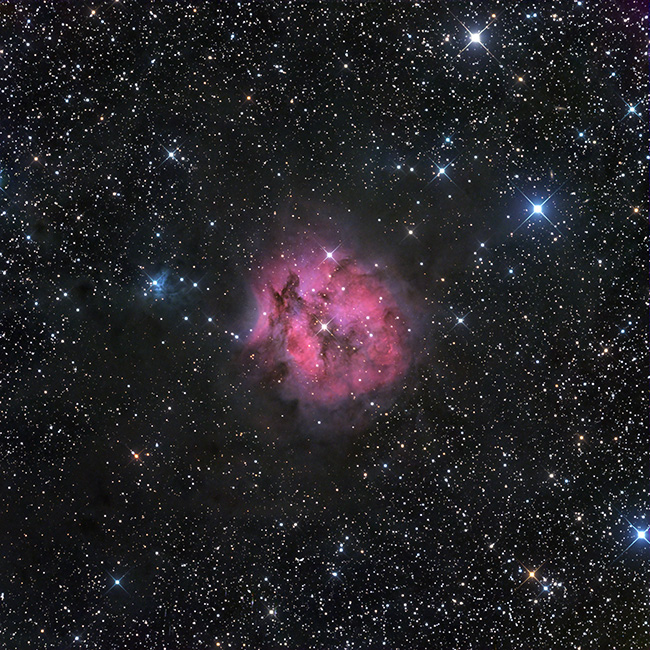
IC 5146, commonly known as the Cocoon Nebula, lies in the constellation Cygnus (the Swan) at an estimated distance of 3,300 to 3,900 light-years from Earth. The bright central nebula spans approximately 15 light-years and is part of a larger complex of interstellar gas and dust[1]. The prominent central star (BD +46°3474[4]) provides much of the ultraviolet radiation that ionizes the surrounding hydrogen gas, producing the characteristic red hydrogen-alpha (Hα) emission. Surrounding the bright emission nebula, interstellar dust reflects and scatters starlight, producing the delicate bluish regions visible in the image. The contrasting emission and reflection components contribute to the Cocoon Nebula's distinctive appearance[1,4]. The Cocoon Nebula is an active stellar nursery containing a young cluster of stars with an estimated median age of approximately one million years. Many of these stars are still in their early stages of development. The prominent central star is a hot, luminous B-type star whose ultraviolet radiation illuminates and ionizes the surrounding gas. According to Gendler, this star began shining approximately 100,000 years ago[4]. IC 5146 is associated with an extensive obscuring molecular cloud designated Barnard 168 (B168). Portions of this dark cloud extend diagonally across the image, from the lower left toward the upper right. Its presence is evident in the noticeable reduction in the number of visible background stars[2,4]. Located just to the left of the Cocoon is a prominent blue reflection nebula cataloged as van den Bergh 147 (vdB 147). Its blue appearance results from starlight scattered by interstellar dust. A close-up view of vdB 147 may be viewed here[3]. Dr. Robert Gendler has published an informative and detailed article describing the Cocoon Nebula, its structure, and its stellar population. His article may be viewed here[4]. Image orientation: North is up; east is to the left.
Member of the Dark Sky Observatory Collaborative
References
2NASA/JPL-Caltech/UCLA (2010). Cosmic Cocoon. NASA Photojournal, PIA13441.
3 Popov, V., & Ivanov, E. IC 5146 (Cocoon Nebula) and vdB 147 in Cygnus. IRIDA Observatory.
4 Gendler, R. The Cocoon Nebula (IC 5146, S125) - Robert Gendler Astrophotography. |
