

|
Date: Nov. 14/15, 2025 - Location: Dark Sky Observatory - Fort Davis, Texas
Click on the image to view at higher resolution. |
|
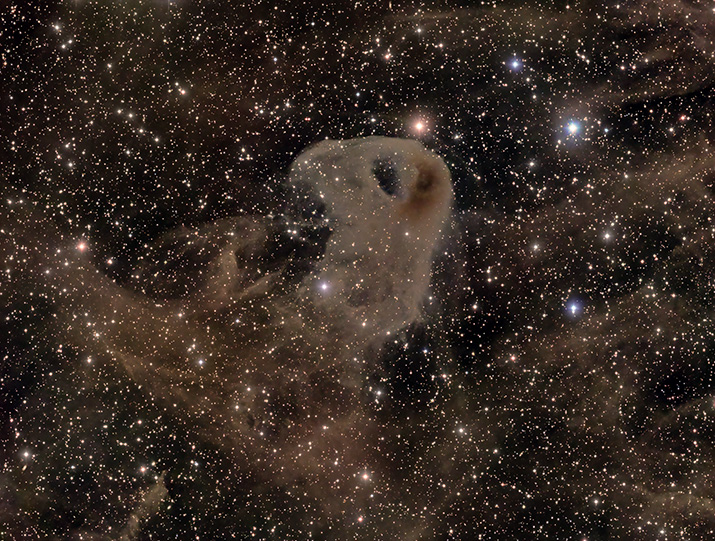
Located about 400 light-years away in the constellation Taurus, LBN 777, popularly known as the Baby Eagle Nebula, is part of the vast Taurus Molecular Cloud complex[1,3]. The nebula's shape, which loosely resembles the head of a young eagle with a prominent dark "eye", gives rise to its nickname[2]. Unlike the brightly glowing, and colorful, emission nebulae often seen in star-forming regions, LBN 777 shines primarily by reflected starlight. The nebula's characteristic brownish coloration arises from large dust grains mixed with the surrounding gas[4]. These particles scatter and reflect the longer wavelengths of light from nearby and embedded stars, producing the warm, dusty tones, seen throughout the image[2]. Just to the right of the nebula's "eye" lies a compact patch of obscuring dust cataloged as Barnard 207[4]. This small dark nebula is classed as a cometary globule[5] and is known to host the Class I protostar - IRAS 04016+2610[5].
Member of the Dark Sky Observatory Collaborative
References
|
