

|
Date: May 6, 2026 - Location: Dark Sky Observatory, Davis Mountains, TX Telescope: 16 inch RC Mount: Paramount MEII Camera: FLI 16803 Exposure: L = 12x600 sec. Bin 1x1 - RGB = 12x300 sec. each Bin 2x2 - Ha = 9x600 sec. Bin 2x2 Click on the image below to view at higher resolution. |
Scroll down to view image description.
|
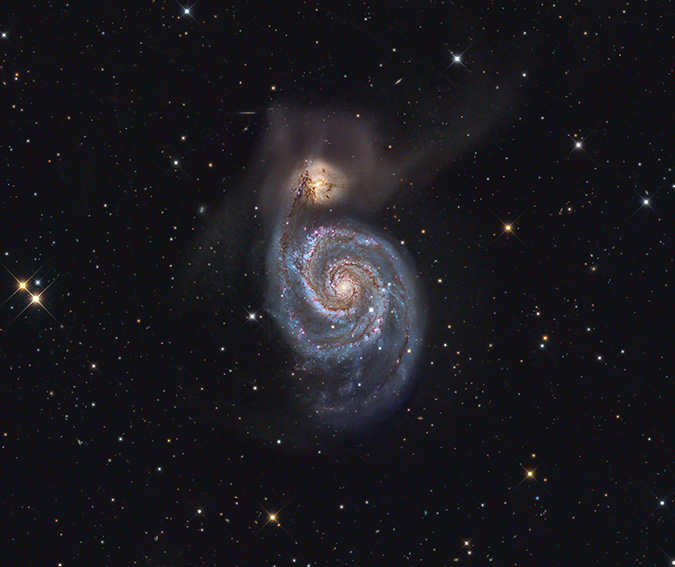
Note: This image is oriented with north to the top and east to the left.
Located approximately 31 million light-years away in the constellation Canes Venatici, M51, commonly known as the Whirlpool Galaxy, is one of the finest examples of a grand-design spiral galaxy visible from Earth[1,2]. The system consists of two interacting galaxies: the larger spiral galaxy NGC 5194 (M51A) and its smaller companion galaxy NGC 5195 (M51B). M51 can be found near Alkaid, the end star in the handle of the Big Dipper[1] The graceful spiral structure of M51A is believed to have been enhanced by repeated gravitational interactions with NGC 5195[2,3]. These tidal interactions have compressed interstellar gas and dust within the spiral arms, triggering widespread regions of star formation visible as pink hydrogen-alpha emission nebulae throughout the galaxy[1,2]. Dark dust lanes trace the inner structure of the spiral arms while faint tidal features extend outward from the interacting pair. Although both galaxies have been affected by their mutual gravitational encounter, the larger mass of M51A has allowed it to retain much of its organized spiral structure, while the less massive M51B appears far more disrupted and distorted[2,3]. Much of the visible distortion in M51A is concentrated in its outer spiral arm structure, particularly the prominent arm that appears to extend toward and connect with NGC 5195. This bridge-like feature is believed to be the result of tidal forces generated during past close encounters between the two galaxies[2]. The luminance integration in this image also reveals extremely faint tidal debris extending north of NGC 5195. (M51B) These low surface brightness structures are associated with the complex gravitational interaction history of the M51 system[4]. The broad feature extending toward the northwest is commonly identified as the "Northwest Plume," while a second looping structure extending northeastward is associated with the "Northeast Plume"[4]. Observationally, these plumes appear as distinct tidal streams or shells surrounding M51B and are believed to consist largely of stars stripped from the outer regions of M51A during earlier tidal encounters. Their differing morphology and distribution suggest the interaction history of M51A and M51B likely involved multiple passages rather than a single encounter[4]. The integrated hydrogen-alpha data further emphasizes widespread star-forming regions embedded throughout the spiral arms of M51A, highlighting areas where gravitational compression of interstellar gas has triggered active star formation[1,2]. Together, the faint tidal plumes and bright hydrogen-alpha regions reveal both the large-scale dynamical interaction and the ongoing stellar evolution occurring within the Whirlpool Galaxy system.
Member of the Dark Sky Observatory Collaborative
References
|
