

|
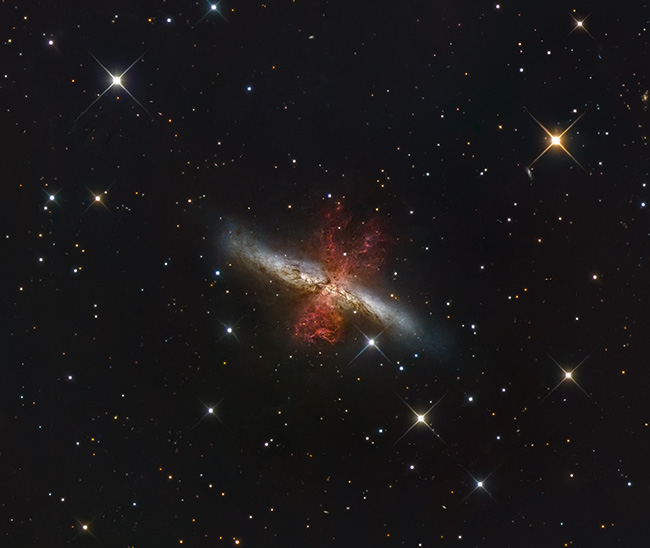
Date: March. 25-26, 2026 - Location: Dark Sky Observatory, Fort Davis, TX Telescope: 16 inch RC - Camera: FLI 16803 Exposure: L = 24 x 600s bin 1x1 - Hα = 20 x 600s bin 2x2 - RGB = 20 x 300s each bin 2x2 Click on the image below to view at higher resolution. |
Scroll down to view image description.
|
M82 is located in the constellation Ursa Major and lies approximately 12 million light years from Earth[1,4]. It is classified as a starburst galaxy[2,5] and is the closest example of this type to the Milky Way[1]. Starburst galaxies exhibit rates of stellar formation at least ten times greater than those occurring in our own galaxy[1]. This elevated rate of star formation is believed to have been triggered by a close gravitational encounter with nearby M81 (Bode's Galaxy)[3]. The interaction between the two galaxies disrupted M82, causing the collapse of gas and dust clouds and initiating widespread star formation[3]. Strong stellar winds and shock waves generated by supernova explosions have produced a sustained chain reaction of stellar birth[4]. The combined effect of these energetic processes drives powerful galactic outflows, visible here as the striking red filaments extending outward from the galaxy's core [5]. These filaments are composed of ionized hydrogen gas emitting strongly in hydrogen-alpha light[5]. This image was captured using LRGB filters with additional narrowband Hα (hydrogen-alpha) filtered data. The hydrogen-alpha signal was blended into both the luminance and red channels in order to enhance the visibility of the outflow filaments originating from the galaxy's core. Image Orientation: north up, east to the left.
Member of the Dark Sky Observatory Collaborative
References
|
