

|
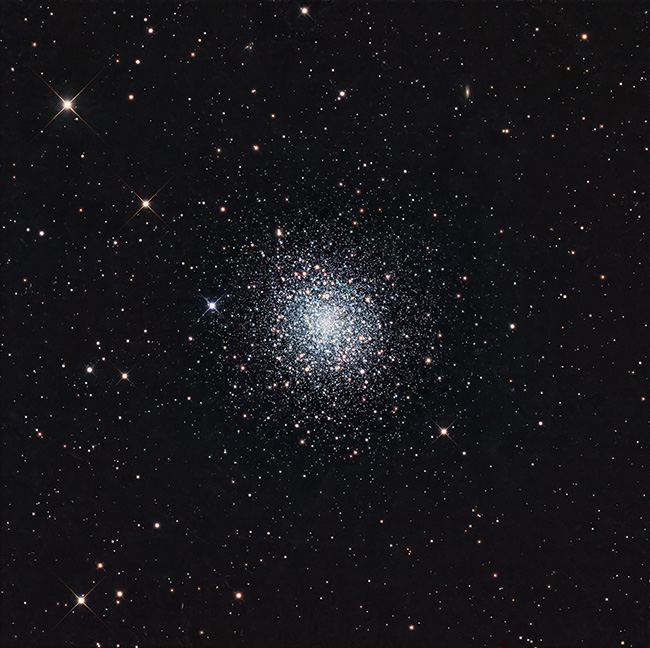
Date: May 24, 2026 - Location: Dark Sky Observatory, Davis Mountains, TX Telescope: 16 inch RC Mount: Paramount MEII Camera: FLI 16803 Exposure: LRGB = 20x60 sec each filter - Bin 1x1 Click on the image below to view at higher resolution. |
Scroll down to view image description.
|
Note: This image is oriented with north to the top and east to the left.
Messier 92 (M92) is one of the finest globular clusters visible in the northern sky, although it is often overshadowed by its nearby companion, Messier 13, the Great Hercules Cluster. Located in the constellation Hercules, M92 lies approximately 26,000 light-years from Earth and resides within the outer halo of the Milky Way galaxy.[1] Globular clusters are nearly spherical concentrations of very old stars gravitationally bound together in compact systems. M92 contains hundreds of thousands of stars packed into a region roughly 109 light-years in diameter.[3] The cluster is classified as a Population II object, meaning its stars possess very low abundances of elements heavier than hydrogen and helium. These metal-poor stars indicate that M92 formed during the early history of the Milky Way, before later generations of stars enriched the galaxy with heavier elements. M92 is considered one of the oldest known globular clusters associated with the Milky Way, with an estimated age exceeding 13 billion years, nearly as old as the universe itself.[3] The cluster likely formed during the earliest stages of galactic evolution, making it a valuable object for studying stellar evolution. At magnitude 6.4, M92 is among the brightest globular clusters observable from the Northern Hemisphere.[2,3] Under exceptionally dark skies it may be faintly visible to the unaided eye. Even small amateur telescopes reveal a rich concentration of densely packed stars, while larger instruments begin to resolve countless individual members extending outward from the bright central core.
Member of the Dark Sky Observatory Collaborative
References
|
