

|
Date: June 22-23, 2026 - Location: Dark Sky Observatory, Davis Mountains, TX Telescope: 16 inch RC Mount: Paramount MEII Camera: FLI 16803 Exposure: Luminance = 24x600s Bin 1x1, Red, Green and Blue = 18x300s each - Bin 1x1 Click on the image below to view at higher resolution. |
Scroll down to view image description.
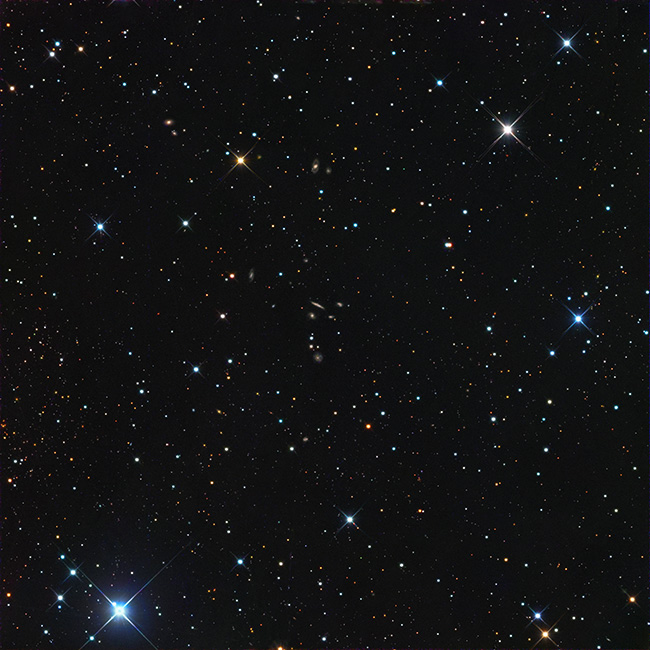
Image oriented with north up and east to the left.
|
Dr. Paul Hickson created the Hickson Compact Group Catalog of one hundred compact groups of galaxies, each consisting of four or more members. He hoped that the catalog would stimulate further observational and theoretical studies of the interesting properties of compact galaxy groups[2]. Located in the center of this image is Hickson Compact Group 80. (HCG 80) It is a compact group of four late-type spiral galaxies located in the constellation Draco, with a mean redshift of z = 0.0299, corresponding to an estimated distance of about 412 million light-years (126 Mpc)[1]. An annotated version of the image identifying the four Hickson member galaxies (HCG 80a–d) and their corresponding PGC designations may be viewed here. Although the galaxies are closely grouped, X-ray observations detected little diffuse hot gas within the group. This suggests that HCG 80 may be in a relatively early stage of compact group evolution, with its intragroup environment still developing before a substantial hot intragroup medium (IGM) has formed[1]. Using Chandra X-ray observations, Ota et al. detected significant halo emission from three of the four member galaxies[1]. The halo emission is particularly prominent around HCG 80a, extending about 30 kpc (˜ 98,000 light-years) from the galactic disk, and is most likely powered by intense starburst activity within the galaxy[1].
Member of the Dark Sky Observatory Collaborative
References
|
