

|
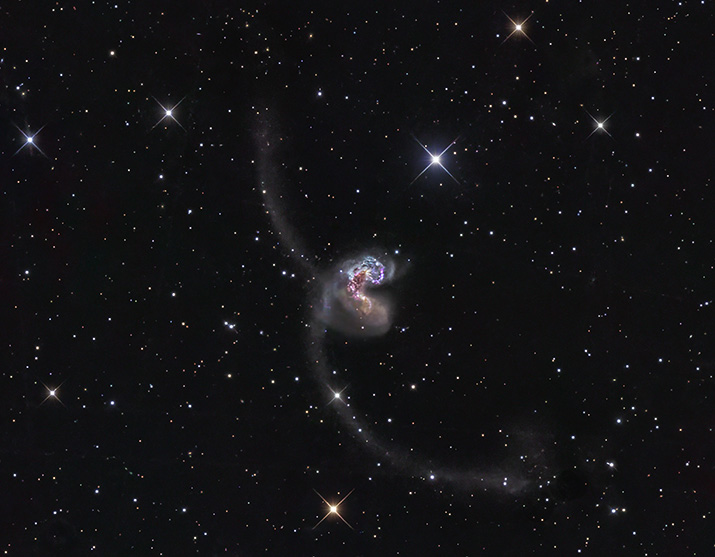
Date: Apr. 22, 2026 - Location: Dark Sky Observatory, Davis Mountains, TX Telescope: 16 inch RC Mount: Paramount MEII Camera: Apogee U8300 Exposure: LRGB = 12x300 sec each filter Click on the image below to view at higher resolution. |
Scroll down to view image description.
|
NGC 4038 and NGC 4039 are a pair of colliding galaxies in the constellation Corvus approximately 45 million light-years distant.[1] The galaxy pair are known as the Antennae Galaxies due to the long streamers, or tidal tails, expelled into the surrounding intergalactic space.[2] To some, these features resemble the antennae of a gigantic celestial insect. About 1.2 billion years ago these two were separate spiral galaxies approaching one another.[3] NGC 4039 (the lower galaxy) is thought to have been the larger of the two and was likely a classic spiral, while NGC 4038 was probably a somewhat smaller barred spiral.[3] Roughly 900 million years ago the pair began to interact gravitationally, and models suggest they passed through one another approximately 600 million years ago.[3] Although the galaxies collided and passed through each other, it is likely that no individual stars actually collided, as the distances between stars are far too great for direct stellar impacts to be common. The same is not true for the giant clouds of gas and dust within the galaxies. These collided violently, triggering an intense burst of star formation that created billions of new stars.[4] The gravitational interaction not only disrupted and destroyed the original spiral structure of both galaxies, but also expelled stars, gas, and dust outward to form the spectacular antenna-like tidal tails seen here.[2][3] Their merging dance will continue for many millions of years, with the eventual outcome expected to be a single giant elliptical galaxy.[3] Much like what is occurring in the Antennae Galaxies, the distant future of our own Milky Way and the Andromeda Galaxy may involve a major gravitational interaction. Earlier models predicted a near-certain collision between the two galaxies in roughly 4 to 5 billion years, but more recent studies suggest the outcome is less certain, with current simulations indicating only about a 50% chance of merger within the next 10 billion years.[5] A close encounter without direct merger remains a plausible alternative. Should a merger eventually occur, the resulting interaction may resemble, on a much larger scale, the galactic upheaval now seen in the Antennae system.
Member of the Dark Sky Observatory Collaborative
References
|
