

|
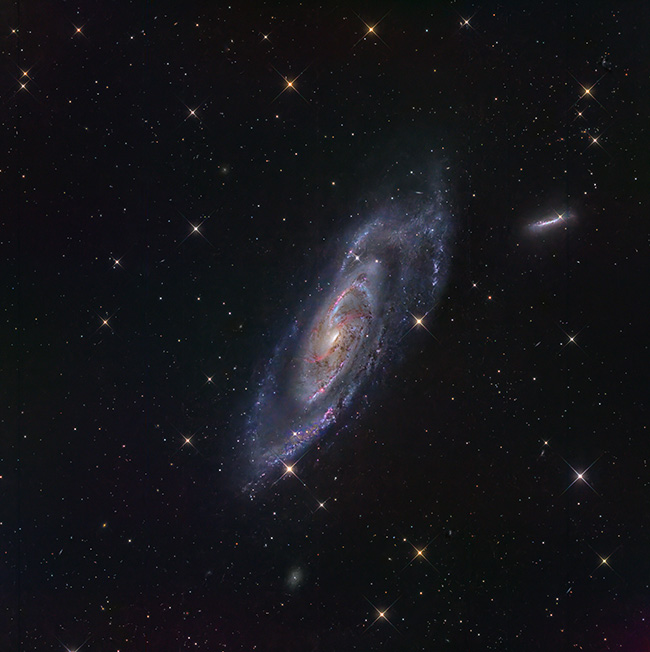
Date: March. 09, 2026 - Location: Dark Sky Observatory, Fort Davis, TX Telescope: 16 inch RC - Camera: FLI 16803 Exposure: Luminance = 12 x 600s - Red, Green, and Blue = 12 x 300s each - Hα = 6 x 600s Click on the image below to view at higher resolution. |
Scroll down to view image description.
|
Discovered by Pierre Mẽchain in 1781[1]. M106 (NGC 4258[2]) is located in the constellation Canes Venatici. The distance to this galaxy is approximately 23.6 million light-years (7.2 Mpc)[2,3]. M106 is classified as SAB(s)bc, intermediate between a barred and an unbarred spiral galaxy, contributing to its distinctive and somewhat asymmetric appearance[1,4]. It is an active galaxy, exhibiting strong emission in the radio, X-ray, and other high-energy portions of the electromagnetic spectrum, and is therefore classified as a Seyfert 2 galaxy[2,4]. A supermassive black hole, with a mass of approximately 4x10⁷ solar masses, resides at its core and powers this activity[3]. Two prominent "red streamers" of ionized hydrogen extend from the central regions of the galaxy. These features, revealed in Hydrogen-alpha (Hα) imaging, correspond to the so-called "anomalous arms", which are not typical spiral arms but are instead thought to arise from jets interacting with the galactic disk[2,4]. In this image, dedicated Hα data were integrated into both the red and luminance channels, enhancing the visibility of these anomalous arms as well as discrete HII regions embedded along the spiral structure. These Hα structures bear some visual similarity to the filamentary outflows observed in the starburst galaxy M82, though they probably originate from different physical mechanisms. The small galaxies visible in the field include NGC 4248 (upper right of M106) and UGC 7358 (below center of M106), both members of the M106 galaxy group. NGC 4248 is considered a probable companion galaxy, while UGC 7358 is a nearby dwarf system likely associated with the same group.
Member of the Dark Sky Observatory Collaborative
References
|
