

|
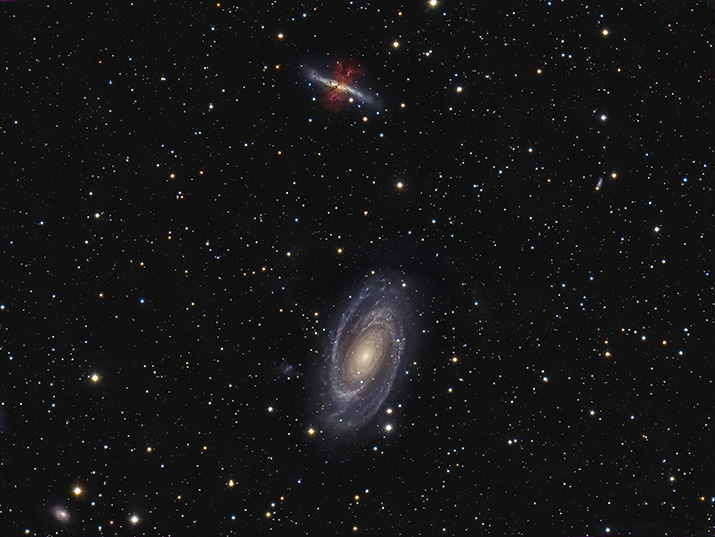
Date: Mar. 24, 2026 - Location: Davis Mountains west of Fort Davis, TX Telescope: Officina Stellare f/3 RH200-AT - Camera: QSI-640 - Mount: Paramount MX Exposure: Lum,Red, Green, Blue = 15 x 5 min each filter Click on the image below to view at higher resolution. |
Scroll down to view image discription.
|
M81 (NGC 3031) is one of the most prominent grand-design spiral galaxies in our sky. It, along with its close neighbor M82, forms the core of the M81 Group and remains a frequent target for amateur and professional astronomers. M82, also known as the Cigar Galaxy, passed in close proximity to M81 in the past. While the exact timing remains uncertain, scientific research has placed the it as much as 600 million years[1], however, it may be as little as 200 million years[5]. This encounter gravitationally distorted both galaxies. M82, being the less massive system, was disrupted to a significantly greater extent than M81. The interaction triggered an intense burst of star formation in M82 that continues to the present time. M82 is therefore classified as a starburst galaxy and is one of the most active nearby systems. Numerous supernova events and strong stellar winds have driven large-scale bipolar outflows perpendicular to the galaxy's disk. These outflows are visible in this image as red H-alpha filaments extending above and below the galaxy[2]. M81 also exhibits evidence of the past interaction, although in a more subtle form. Its outer spiral structure shows mild asymmetry and distortion. Visible to the left of M81 in this image is Holmberg IX, a dwarf irregular galaxy believed to have formed from tidal debris generated during the interaction between M81 and M82. Holmberg IX is dominated by young stellar populations and active star formation, supporting the interpretation that it is a relatively recent tidal dwarf galaxy rather than a long-standing independent system[3]. M81 is viewed nearly face-on from our perspective, revealing its well-defined spiral arm structure and bright central bulge, making it one of the most frequently imaged galaxies. In contrast, M82 is seen nearly edge-on, highlighting its disturbed morphology and energetic outflows. M81 and M82 lie in the constellation Ursa Major at a distance of approximately 12 million light-years from Earth[4].
Member of the Dark Sky Observatory Collaborative
References
|
